


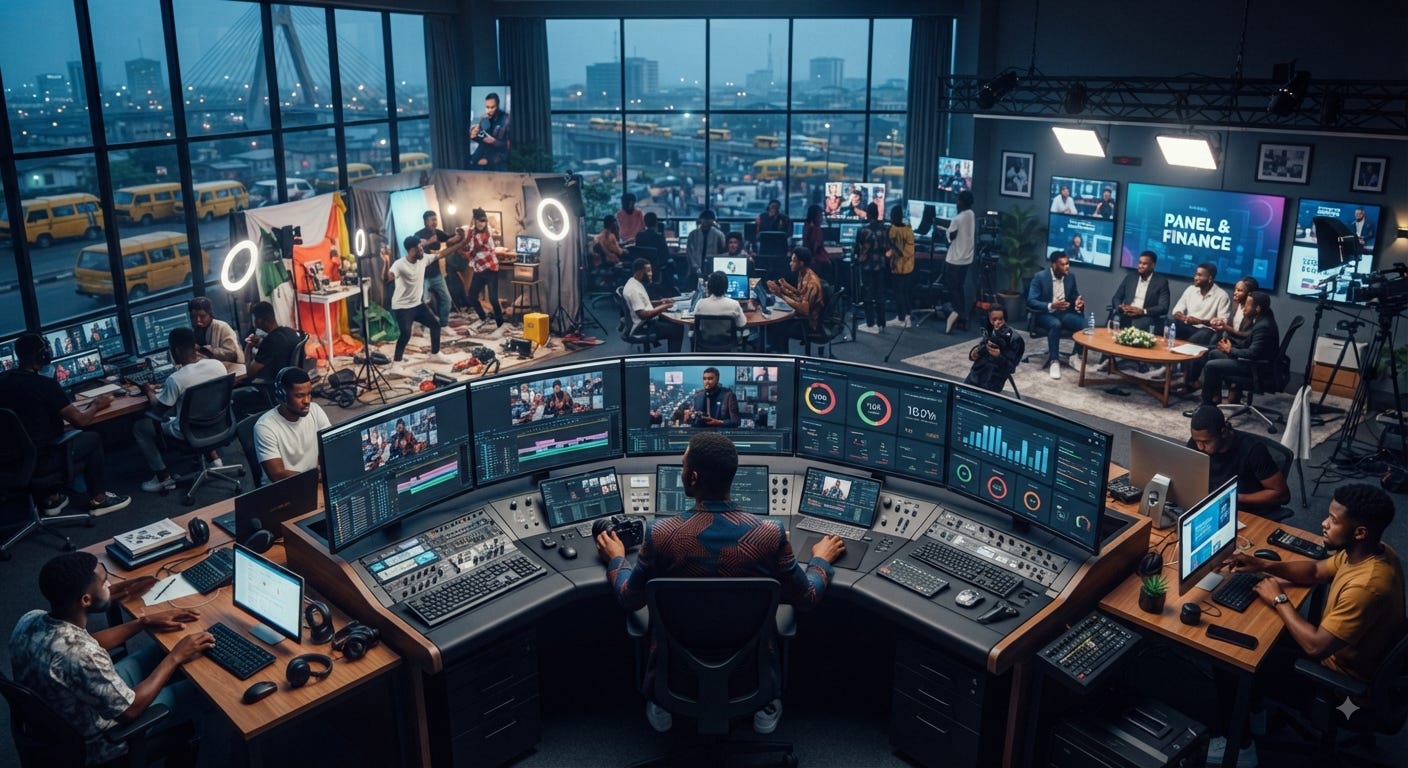
TL;DR
Nigeria doesn’t have an intelligence problem as much as it has a participation problem. Intelligent content exists, but it isn’t being produced, distributed or supported at the scale required to shape mainstream culture. If we want better culture, we have to stop complaining about what wins attention and start competing for it.
Definitions:
Olódo (oh-low-dow) is a Yoruba word directly translating to “someone who owns/scores zeros”, essentially meaning a dullard, but functionally, someone who is incurious and contemptuous of learning.
ọ̀mọ̀wé (ore-more-way) is Yoruba for ‘the one who knows books’, meaning an intellectual, or a learned person.
The first time the phrase “Olódo Uprising” was coined, as far as I can trace, was on the 31st of August 2025 by Twitter/X user @Chi_deera.
However, the phrase found a new life and became popular when Nigerian rapper YCee used the term on the Afropolitan Podcast in late June 2026. His argument, summarily, was that Nigerian society is no longer celebrating academic excellence, that fewer young people want to go to school, and that the culture has shifted beyond “Yahoo culture” (glorification of internet fraud) into what he called “Peller culture”: a culture that rewards outrageous, unintelligent or performative ignorance with massive views, clout and money.
In essence, “Olodo Uprising” has become a publicly understood term for the perceived surge of anti-intellectualism.
Is there merit to the claim?
I’d say yes, and no.
Yes, slapstick entertainment, creator culture and broad social commentary are truly mainstream in Nigeria.
No, because “Olódo Uprising” is largely a symptom of two deeper problems: the decay of the Nigerian educational system, and the apathy of the educated class towards occupying and shaping the spaces where mainstream culture, entertainment and public opinion are produced.
When the educational system goes bad, it is not the fault of the uneducated that there is limited access to quality education. In fact, ignorance and anti-intellectualism are natural consequences of a failing educational system. Fixing that is generational work, and it must be done. But it is not the only work available to us today. The second problem is much more immediate.
When the educated fail to participate in or shape public culture in major ways, that is an open void for anyone to fill.
So who exactly do we expect to fill the void?
When something goes bad, the people who can recognise the problem must step in to fix it, not merely bemoan or comment about it. Fixing is insistent and perpetual advocacy. Fixing is building alternatives, participating, organising, producing, funding, teaching, publishing, and COMPETING.
The general excuse that “Nigerians don’t respond to intellectual content” is a flat-out fallacy. Time and time again, we’ve seen intellectual content go viral and receive the appreciation it deserves when it is presented in formats that respect the sensibilities and leverage the sentiments of its audience. It’s called cultural fluency.
The likes of Aproko Doctor, Healthertainer and Elizabeth Adewale find relatable and comical formats to inform the public on various health matters. ISWIS podcast and Zikoko are contributing immensely to youth culture, and ‘Comrade’ Dr Ola Brown shares complex business and investment ideas in easily digestible formats.
The audience is not necessarily rejecting intelligence. It is rejecting boring delivery.
But even that is half the story.
There is a significant minority of people already creating the kind of intelligent, thoughtful and culturally relevant content we claim to want more of. The problem is that they are often doing so with a fraction of the volume, distribution, and audience support of the content we complain about.
If there are 10,000 creators producing entertaining slapstick content and a few hundred producing intelligent content, of course the former will feel more ubiquitous. That doesn’t necessarily mean Nigerians have rejected intelligence. It means there is simply far more of one thing competing for their attention. It is a volume game, and volume eventually becomes visibility. Visibility becomes cultural familiarity, and cultural familiarity becomes influence.
And volume alone is still not enough. Content does not distribute itself; audiences carry it. The ones we call “Olódos” understand this instinctively. They are perpetually on TikTok ‘gifting’ their creators in small to big ways, sharing their videos, defending them in comment sections, and showing up at their events. They behave like stakeholders in their creators’ success. Meanwhile, the people who claim to want more intelligent culture will watch a brilliant piece of work, nod approvingly, and move on without so much as a repost. No subscription, no share, no recommendation, no funding. We treat appreciation as a private act when it needs to be a public one. We cannot complain about the dominance of one kind of content while refusing to give the alternative an audience.
Here is the real problem: the educated class has shown remarkably little ambition to shape and push what millions of Nigerians think, watch, read, listen to or aspire towards. Our problem is more ọ̀mọ̀wé apathy than it is olódo uprising.
Peller, Carter Efe, etc., for better or worse, are embodiments of ambition a big FU to the cluster of excuses many intellectual creators have.
Peller is mocked for his English. Carter Efe is regarded by many as unattractive; worse still, he gleeks like mad. But they wake up everyday executing a masterclass in volume, grit, and radical self-acceptance.
They are constantly evolving their formats, forcing their way into circles they’d typically be unwanted in, and doing all it takes to go international - refusing to internalize the limitations we use to decide who “belongs”.
How’s that not inspiring?
I don’t even admire what they produce. But they sure as hell demonstrate strong entrepreneurial and cultural ambition. So I think it is quite arrogant and irresponsible to call them olódos. That’s our own failing.
Our mistake is treating the people who are winning the ‘attention economy’ as evidence of intellectual decline, rather than asking why the educated class has largely abandoned the arena in which attention, culture and influence are now being produced.
Creators have a responsibility to learn how to communicate, entertain and compete for attention.
But there is also a responsibility on the people who claim to want something better.
If there are ọ̀mọ̀wés already creating the content we say we want, let’s support them.
If the content is badly packaged, let’s give helpful feedback to help make it better.
If it is good, let’s ‘share aggressively’.
If it is great, let’s fund it.
Occupying cultural space is not a spectator sport.
We have serious work to do to make sure Nigeria eventually has an educational system capable of producing curious, rigorous and intellectually confident citizens at scale. Meanwhile, it is the responsibility of the educated class to intentionally occupy space en masse.
👌🏽